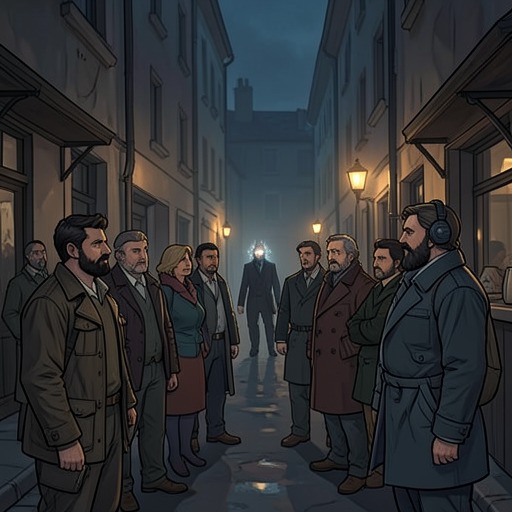
First Street Mayfair mansion
Blood CanticleThe First Street Mayfair mansion is a family home in which inherited history becomes difficult to distinguish from the present. Its formal rooms and expansive garden hold memories of the Mayfair family’s past, while the house’s ghosts and Rowan’s breakdown make that past an active force. In the garden, the story’s domestic setting converges with death: Rowan remembers burying her daughter beneath an oak where another grave already lay.
Grounds and Family Memory
The mansion is introduced through the grounds Quinn remembered from the summers when he visited Mona: crape myrtles pressed against a black fence, two sentinel oaks whose roots broke through the flagstones, and a concealed side yard stretching into darkness. The pool glitters beyond the house, while the garden also contains the graves associated with the family’s Taltos history. The grounds are not merely a picturesque approach to the residence. They preserve the places where family knowledge was passed on and where its consequences were later buried.
In that side yard, Oncle Julien had drawn the young Quinn aside and told him about his Mayfair blood, warning him never to marry Mona. The garden thus carries both the intimacy of Quinn’s youthful visits and the constraint imposed by the family’s secrets. Its beauty and concealment coexist: the open, sunlit space is also the setting of a warning whose effects reach into the present.
Rooms and Inherited Presence
The double parlor’s white-marble fireplaces and soaring mirrors multiply the room’s length and shadow. Ancestors’ portraits look out over scattered furniture, a long Bösendorfer piano beneath a veil of dust, and a tall German clock that continues to mark time. The room’s arrangement joins ordinary domestic use to accumulated family history; the portraits include Julien, making the past visible among the furnishings rather than safely remote from them.
The house’s unseen presences intrude on this ordered interior. Michael hears movement and asks where the others are; the narrator senses that the spirits dislike the visitors. The scene does not resolve the hauntings into a clear explanation. Instead, the mansion’s familiar rooms become a place where living occupants and family ghosts seem to overlap.
The library and stairs intensify that unease. Michael explains that the library was added in 1868 and points out its plasterwork and wall of old leather-bound books. Mona studies the room and its lace curtains, while Michael’s memory registers a threat at the window and Rowan’s vulnerability. On the narrow hallway stairs, the narrator senses mortal death and imagines a fall, associating the staircase with a fatal history. The house’s architecture therefore supplies more than atmosphere: rooms and passages seem to retain danger and memory even when the evidence does not fully explain them.
Rowan and the Garden Graves
When the visitors reach Rowan, she is seated alone at a table, dressed in a dark purple robe. Her recognition gives way to a conviction that Mona is dead. She calls for Michael to get Mona and insists they bury her beneath the tree, then tries to reach her while Michael holds her back. Mona recoils, and Quinn struggles to restrain her. Rowan’s plan to dig deeply so Mona will never return turns the garden into a projected burial place: the family’s actual history of graves is repeated in her breakdown as an urgent, mistaken attempt to contain death.
Later, Rowan recalls the death that stands behind the scene. She says that the Taltos girl had made her way to the house as Rowan had taught her and had restored Rowan to consciousness with her milk. Rowan attributes her own distorted response to her loathing of Lasher, her revulsion toward the unfamiliar species, and her own atavistic behavior. The girl died; after waking from a coma, Rowan buried her beneath the oak. Rowan’s recollection establishes that two graves lay beneath that tree, and that the burial she once carried out becomes entangled with her later insistence that Mona, too, must be buried.
A House That Holds the Past
The mansion’s defining tension lies in the way its domestic details and family history occupy the same spaces. Mirrors, portraits, books, curtains, and the old clock give the rooms a material continuity, while the garden and staircase carry associations with warnings, death, and burial. The house does not simply shelter the Mayfair family: it stores the memories through which family relationships and old secrets return to the living.
That continuity is especially painful in Rowan’s story. Beneath the oak, a real grave recalls her guilt over the daughter she could not save; at the table, her attempt to bury Mona gives that remembered loss a new and frightening form. The mansion’s history is therefore neither a finished record nor a backdrop. It persists in rooms and grounds, shaping what the characters perceive and how the past reappears in the present.